

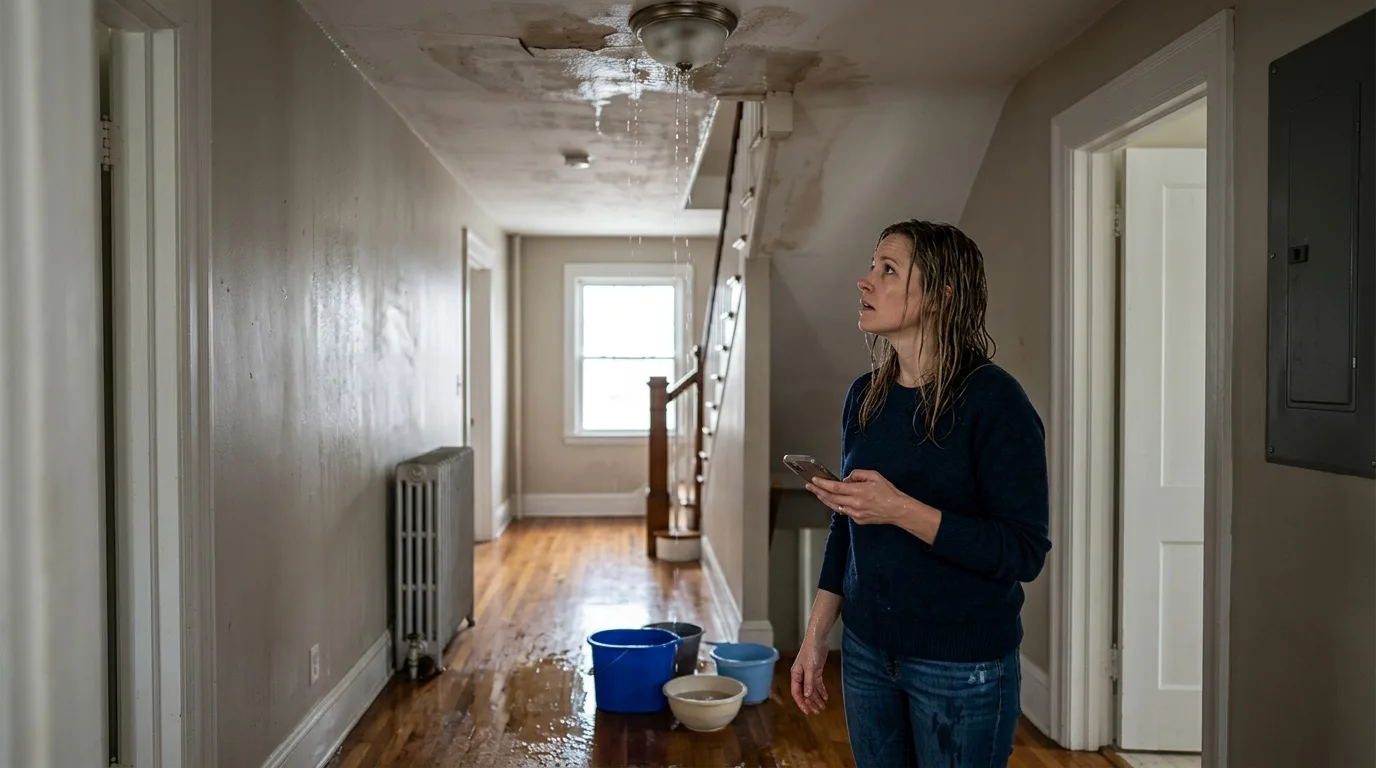
Picture a long-awaited day off. The plan is to order good food, watch a show and stay in bed as long as you like. Then you step into the bathroom and you are standing ankle-deep in water. Panic sets in, you start calling and texting friends. The water, meanwhile, keeps coming.
It looks like there will be no rest today. For a water leak, who to call depends on where the leak happened, and so does the rest of the plan. The main thing is not to panic and to keep a cool head. If you act quickly, you can avoid a lot of the consequences.
Below we go through it by situation: a pipe or fixture, the roof, the water line before the meter, hidden leaks and standing water. Then what to tell the people you call, the insurer, and checking licenses.
Leak in the water supply: call a plumber
If a pipe, a faucet connection or a fixture is leaking inside the house, this is the plumber's job. Before the call, do the following.
- First, shut off the water - hot or cold. Shutoff valves are on the supply pipes and are most often installed in the bathroom, under the kitchen sink or in a utility area next to the kitchen. Turn the valves clockwise. If there are lever handles instead of valves, turn them across the pipe. If you cannot find a local valve, use the main shutoff for the house.
- Turn off the power in the room. The breaker is in the electrical panel.
- Report the leak. During business hours call a plumber. If it happened at night or on a weekend, call an emergency plumbing service. In a condo or apartment, also tell the HOA or the property manager - they may send their own plumber.
- Deal with the water. The sooner you collect the water, the lower the chance of flooding the neighbors below.
- Get ready for the plumber's visit - make sure there is free access to the pipes. Move everything that is in the way.
If water is getting onto electrical wiring or the ceiling may come down, cut the power at the panel and stay out of that room. Say this separately when you call, so the people coming know about it.
A sewer pipe is leaking
Notice an unpleasant smell? That is a common sign a drain or sewer pipe is leaking. You will not be able to shut it off. If you find the spot of the leak, wrap it tightly with a thick rag, wearing rubber gloves.
During business hours, get through to a plumber. On weekends, call an emergency service directly. If you can, clear access to the pipe. Leave pipe replacement to a licensed plumber.
Sewage water is not something to clean up with a mop and a bucket. Floors and walls it has soaked into need proper cleaning and drying, and that is where a water damage restoration crew comes in after the plumber.
A hot water line has burst
Call for emergency help first. Turn off the water heater supply and switch off the breakers in the panel. Keep away from the burst so you do not burn yourself.
Once it has cooled, collect the water as quickly as possible. The less water there is on the floor, the better the chance it will not seep through to the neighbors below.
Water from the ceiling: who to call
A wet stain spreading across the ceiling while rain drums outside - for a water leak ceiling who to call depends on what is above you. If there is an attic and roof above the room, it is a roof leak, and who to call is a roofer. If there is another unit or a bathroom above, it is most likely a pipe, and the plumber goes first. Either way, act quickly.
- Report it. In a condo or apartment, call the HOA or property management and ask them to send someone. Note the time of the call and the name of the person you spoke to. Back up the call with an email.
- If water is pouring, wiring is affected, or walls or ceilings may collapse, call emergency help. Do not wait for business hours.
- Take safety measures. Cut the power to the room. Warn the neighbors.
- Put out containers where the ceiling is dripping, get your things out from under the water and move small furniture out of the leak zone.
- Record the leak. Take photos or video of the stains on the ceiling and walls, the puddles on the floor and the belongings that got damaged. Shoot both wide and close up.
Things like furniture, documents and electronics that are in the way of the drying work can be moved out and stored - that is what pack-out and contents services are for.
Water line leak before the meter: the water department
The rule is simple. If the pipe broke on your side - inside the house or on the line from the meter to the house - responsibility usually lies with the owner. Check with your water department which part of the line is yours. For a water line leak, who to call in that case is a plumber.
A break on the shared line is a different matter. The pipe up to the meter and the main in the street are the water department's. If water is coming up at the meter box, in the street or on the sidewalk, call the city water department's emergency line. Only their crews can shut off and repair the main.
A leak on the line can give itself away by lower water pressure, damp ground around the house and a wet foundation. Usually the water just goes into the ground.
Hidden leaks: who to call to check for water damage
In modern homes pipes are often hidden inside the slab or a wall. A leak does not start out of nowhere; there is always a reason.
- Old pipes. Worn-out lines are typical of older buildings. Modern quality materials last much longer.
- Tees, joints and fittings inside the slab. Connections are the weak spot of a pipe system. Installers try to keep them out of the slab.
- Equipment mistakes. For example, no expansion tank, or the wrong size. Excess pressure builds up in the pipes and damages them.
- Poor soldering and assembly mistakes.
- Defective material.
The main difficulty is finding the damage. Sometimes even the fact of a leak is hard to spot.
Signs that something is leaking
- Wet spots. Usually they show up not on the floor but at the bottom of the walls. Wallpaper and paint start to peel, drywall and plaster get wet, mold appears. In multi-story buildings the neighbors below usually notice first, when a wet stain forms on their ceiling.
- Swelling of hardwood, laminate or engineered flooring. The materials soak up the water and warp.
- A drop in water pressure.
- Higher humidity in the room.
The ruined finish is not the worst part. Hidden damage is the serious danger. Moisture inside framed walls means rotting wood. Insulation gets wet and stops working. Wood soaks up moisture almost without any signs, especially under a finish. On the outside it looks the same, while inside it is rotting. Tile hides it for a long time too, while the damp tile adhesive loses its hold. A bit earlier the grout lines can give it away by changing color or seeping drops. Mold on the walls can be the result of a leak, and that is a job for mold remediation specialists, not just a coat of paint.
How technicians find leaks
Technicians start in the rooms where most of the lines are - the bathroom, the laundry room, the kitchen. When the spot cannot be found by eye, they use equipment.
- Moisture meter. It gives the moisture level as a percentage. But often it just confirms that moisture is high.
- Thermal camera. It tracks temperature changes. It works well when a hot water pipe is leaking. Cold water is harder, since the temperature difference between the water and the air is small. Leaks under tile are especially hard to catch.
In general, the process goes in this order:
- Technicians find out which system is leaking - water supply or drain lines.
- Then they find the room where the leak is.
- The last stage is locating the area of the leak in the slab. Usually it is pinned down to a small area.
After that, repair crews, plumbers and companies that dry out buildings get to work.
When to call a water restoration company
The plumber, the roofer or the water department stops the water. They do not dry the house. When to call a water restoration company: when there is standing water on the floor, when walls, flooring or ceilings are wet, or when the leak has been going on unseen and the signs above are already there. The less time water sits in the materials, the less there is to tear out later.
For a business it is the same order, with one more concern - keeping the doors open. We wrote about it in keeping your business open during restoration.
Emergency or next day
An emergency water leak - who to call right away, at night or on a weekend:
- Water is pouring and you cannot shut it off.
- Water is on the wiring or near the electrical panel.
- The ceiling is sagging or walls may come down.
- Water is coming up in the street or at the meter - the water department.
If the water is shut off, the power is safe and there is only a stain or a slow drip, the plumber or roofer can usually come during business hours. Wet materials, though, should not wait long.
What to tell them
- Where the water is coming from, if you know - a pipe, a fixture, the ceiling, the street.
- Whether you managed to shut off the water and the power.
- All the risks: water on the wiring, a sagging ceiling, sewage.
- Which rooms are affected and whether water has gone to the neighbors.
- Get a ticket or job number, and write down the time of the call and the name of the person you spoke to.
Telling the insurer
If you found the spot of the leak, photograph it. Also record all the consequences of the flood. Photos and video will be needed by the insurer.
Things will be much easier if the home is insured. Notify your insurance company. In the claim, list all the losses; keep receipts and bank statements. Hidden damage can show up later; if it does, tell your insurer.
If you rent, tell the landlord about the leak in any case. In a condo, also tell the HOA, and the neighbors who got water as well.
Checking licenses
Do not take apart or install pipes yourself. Bring in plumbers for this work. Whoever you hire in California - plumber, roofer or restoration contractor - check the contractor's license first with the CSLB online license check. To see who we are, read about our team and work and what our customers say in reviews.
Tips for homeowners
We hope you never face this problem. But it is better to be safe. Here are a few recommendations.
- Find out where the pipes are and the valves that shut off the water, including the main shutoff.
- Write down the numbers of a plumber, the HOA or property manager and the water department. In an emergency you will save precious minutes.
- Have a plumber do periodic checks of the lines.
In an emergency, remember that panic has never helped anyone. Stay calm, and you will keep the damage to a minimum. More on water, fire and mold in the news and articles section, or go back to the Carlsbad restoration home page.