

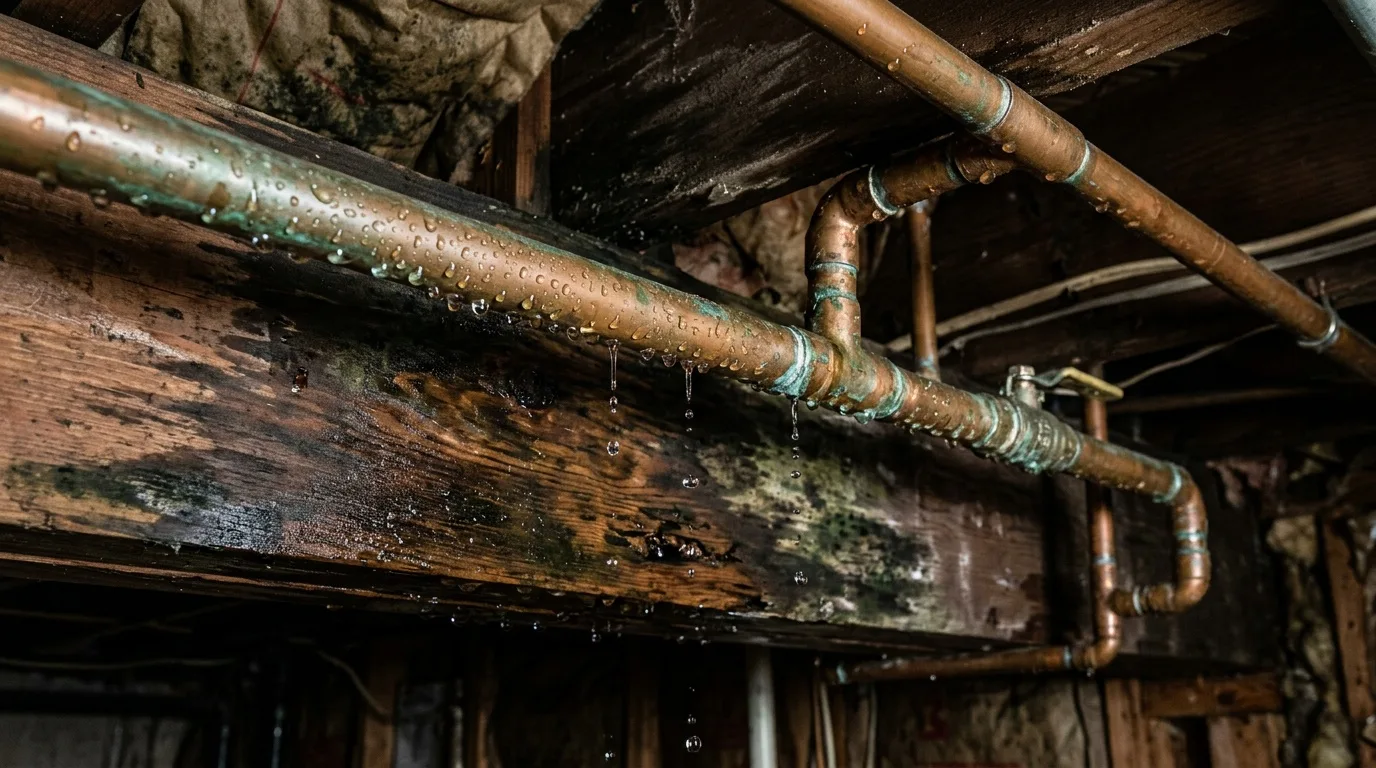
Warm air holds more water vapor than cold air. When it touches a pipe whose temperature is below the dew point, the vapor settles on the surface as drops. This can also happen because of poor ventilation and high humidity in the room.
Condensation on pipes that carry cold water is a common thing in bathrooms and kitchens. Over time it leads to serious consequences. Constant moisture lets mold develop. So it is important to understand where the condensation comes from and to take measures in time.
If condensation regularly shows up on a cold water pipe, wiping it off and forgetting about it is not enough. You need to find the cause, otherwise later you will be getting rid of fungus and repairing the whole bathroom.
Leak or Condensation? The Dry-the-Pipe Test
In most cases condensation comes from a combination of factors, not from one single cause. And these factors usually act on the whole pipe, not on some separate section of it.
Yes, you can just wipe the pipes with a rag. But this is only a temporary measure, and it does not solve the problem at the root. Drying the pipes with a hair dryer is the same: it helps for a while, but within an hour the moisture forms again.
A leak behaves differently. One of the most common causes of water under a sink is a leaking trap, hose or connection. Even a small drop that runs down regularly builds up over time and spreads to the floor. Check the pipes under the sink, especially the joints. If you notice moisture there, call a plumber or replace the gaskets or seals.
Why Pipes Sweat
There are usually several reasons why condensation appears on pipes in a bathroom or half bath. Here are the main ones.
Temperature Difference
When a pipe cools below the dew point, moisture settles on it. In summer, at 77°F and 60–70% humidity, this happens more often, and in a coastal city like Carlsbad humid air is a regular thing. In winter it happens less often, because the air in the house is usually drier, 30–45%.
Cold water in the pipes is, as a rule, colder than the air in the room. The temperature gap can't be avoided if the heat is on or the room is simply very hot. Because of it, like it or not, drops will appear on the pipes.
Poor Ventilation
The most common cause is poor ventilation in the room. If the excess moisture is not removed, the pipes will be wet no matter what. If the exhaust fan is clogged with dust, does not work or is not powerful enough, the air stagnates. After a shower the humidity can jump very high, and all that water settles on cold surfaces.
To check whether the ventilation works, hold a strip of paper up to it. If the paper does not lean toward the opening, there is no draft.
High Humidity in the Room
Drying laundry, cooking, a running humidifier, leaking faucets and toilet tanks — all of this raises the humidity. Even a small, barely visible leak from a toilet tank can cause condensation. Faulty fixtures, a broken faucet or a leak can all become an extra source of moisture in the room.
No Pipe Insulation
A bare metal pipe is an ideal condenser. It has high thermal conductivity, so it cools quickly and holds a low temperature.
Plastic pipes "sweat" a little less, but with poor ventilation they also collect moisture on themselves.
Houses With Crawl Spaces and Attics
Cold water pipe sweating in a single-family house is a frequent problem. The water runs through unheated crawl spaces and attics, and comes colder from a well where there is one.
Where the Damage Shows
Constant dampness from pipes causes mold and corrosion. Here is what it leads to:
- Mold and fungus: they cause allergies, coughing and headaches. When it has already spread, that is a job for professional mold remediation in Carlsbad.
- Rust and decay: metal rusts faster and structures break down, especially in a house — insulation goes soft, wood rots.
- Ruined finishes: laminate swells, wallpaper peels off, dark spots appear on the ceiling.
Condensation on pipes in a ceiling or sweating pipes in walls are harder to see. Sometimes the floor can draw water from inside or from pipes running under it. Especially if the seal at the wall seams or along the baseboards is broken. If the source of the moisture cannot be found from above, it may be coming up from below. In that case it is worth calling a plumber for a thorough inspection, and when drywall, subfloor or framing are already wet, water damage restoration and structural drying is the next step.
Do not ignore the problem: mold and rot will not go away by themselves. The sooner you start acting, the smaller the consequences will be.
Pipe Insulation
The Department of Energy's Building America guide recommends insulating cold water pipes where condensation may be an issue, and notes that condensation on pipes can lead to mold and moisture damage.
To find the cause of condensation, act step by step. If, after the ventilation and fixtures are sorted out, condensation keeps forming, you need to move on to more serious measures. For this it is recommended to insulate the cold water pipes. Different materials can be used:
- Foamed polyethylene: a light, flexible closed-cell foam that is easy to install. It is sold as tubes of different diameters with a slit along the length. Put it on over the pipe and wrap the joint with reinforced self-adhesive tape.
- Foamed rubber: more durable and denser than polyethylene. It does not absorb moisture and lasts a long time. A common thickness is about 3/8 to 1/2 inch. It is sold as tubes that are slipped onto pipes before they are installed in the bathroom, or, as in the previous item, as a sleeve.
- Expanded polystyrene: a versatile and inexpensive material, made as tube-shaped shells or as sheets.
- Mineral wool: handles heat well, but it needs extra protection from moisture (for example, a vapor barrier film). It is convenient to use because it simply wraps around the pipes.
- Polyurethane foam: has high insulating properties, applied by spraying or used as ready-made tube shells.
Any of these insulations must fit tightly against the pipe and have no gaps. Otherwise moisture will condense in the gaps and seams. This method only helps if the ventilation system is in order and the plumbing fixtures work properly.
Humidity Control
First check the ventilation, then inspect all the plumbing fixtures — valves, faucets — for leaks and faults. Repairing or replacing the broken parts, and upgrading the ventilation, often turn out to be enough to solve the problem. On top of that, air out the room when the air outside is drier; on humid days run a dehumidifier or the AC.
In a kitchen, sometimes moisture shows up on the floor not because of leaks but because of condensation — especially if the kitchen is poorly ventilated and there is a big temperature difference in the room. Install a range hood, air out the kitchen regularly, keep an eye on the humidity. In damp rooms dehumidifiers also help.
What Not to Do
Common mistakes that make the problem worse:
- Painting with decorative paint: it does not create a thermal barrier, and condensation will settle on top of it.
- Wrapping the pipe in cloth so it soaks up the water: this only speeds up corrosion.
- Drying the pipes with a hair dryer: it helps for a while, but within an hour the moisture forms again.
When It Is Really a Leak
A wet floor is not always condensation. Check the other sources too:
- Dishwasher: it can leak a little while running — because of a worn seal, a damaged hose or a clogged filter. Check whether moisture appears after a wash cycle. Look under the sink at the dishwasher supply and drain connections; for anything behind the panels, call a technician.
- Refrigerator: models with auto-defrost or an ice maker can collect water in the drain pan or even have small leaks. Look at the back of the refrigerator, check whether the drain pan is overflowing or the drain is clogged.
- Washing machine: a possible cause is a leaking drain hose, drum or loosely fastened connections. Check all the hoses, make sure they are attached firmly and are not worn.
So there is more than one way to stop condensation on cold water pipes. But first of all you have to find out where it comes from, and only then take any measures. Remember that some work (for example, ventilation repair) may need a licensed HVAC technician.
For a wet ceiling, wall or floor in Carlsbad, you can read about our restoration team and see what local customers say in reviews. Businesses can look at keeping a business open during restoration; when furniture has to come out of a wet room, there are contents pack-out and storage services. More guides are on the restoration blog and news and on the Carlsbad restoration home page.
Once More, Briefly
Condensation on pipes is not a breakdown but a normal physical process. Moisture from the air settles on a cold surface when the temperature drops past the dew point.
To solve the problem, act in order: check the ventilation, fix leaks, lower the humidity, and be sure to insulate the pipes. That is how to stop pipes from sweating: this is usually enough to get rid of condensation on a cold pipe.