

Drop by drop — your business slips away
Flooding in an office, store, or warehouse brings shock and panic. But it is precisely in the first hours after the incident that decisions are made which determine whether you get full compensation for losses or face a drawn-out process with insurers and contractors. The real difficulty often lies not in the repair itself but in the organizational procedures tied to property managers, insurance companies, and building maintenance.
Commercial water damage in Carlsbad can cause far greater losses than residential flooding. A commercial space may house expensive equipment, unsold inventory, important documents, and specialized infrastructure. The restoration period halts business operations — sometimes for weeks — and during that time the company earns nothing.
Immediate steps after discovering water damage
The first two hours after discovering a flood are critical for saving inventory and gathering evidence. Here is what should be done right away:
- Shut off electricity through the main breaker panel in the affected zone.
- Turn off the water supply — contact building maintenance or the property manager to shut it off at the main line.
- Evacuate staff from areas where standing water is present.
- Move valuable items, documents, and electronics out of the flooded zone to prevent further losses.
- Take photos and video of the source of the leak, all flooded areas, damaged equipment, and affected inventory.
Call the property management company or building maintenance immediately. Write down the time of the call, the name of the dispatcher, and the work order number. This record confirms you acted responsibly and will matter if an insurance claim is filed later.
Documenting the damage
An official inspection report is the key document. Without this paperwork, signed by all involved parties, proving the extent of water damage becomes very difficult. The report should include:
- Date, time, and full address of the property.
- Composition of the inspection team — building administration, property owner, and the business owner or manager.
- The identified cause and location of the leak.
- A list of all damages with a preliminary assessment — walls, ceiling, flooring, equipment, inventory.
- A note that photo and video documentation was conducted.
- Signatures of everyone present.
It is advisable to conduct two inspections. The first on the day of the flood, and the second about ten to twelve days later to identify additional damage that may not be visible immediately — warped flooring, paint peeling away from walls, hidden moisture behind drywall.
Sorting and cataloging damaged property
For businesses with physical inventory — retail stores, restaurants, warehouses — the inventory step is essential. Damaged goods should be separated into two categories: items that are a total loss and items that can potentially be saved.
A detailed register should list the name, description, quantity, purchase price, and reason for the loss of each item. Keep all damaged goods in place until insurance adjusters or independent assessors have completed their review. Throwing items away before this point weakens any future claim.
Getting a professional assessment
An independent assessor translates your losses into specific numbers. For commercial water damage in Carlsbad, the assessment typically covers:
- Cost of repairing the space — drying, replacing drywall, flooring, painting.
- Lost revenue during the period the business cannot operate.
- Depreciation or replacement cost of damaged inventory.
- Damage to equipment — refrigeration units, computers, point-of-sale systems, specialized machinery.
Without a formal assessment, your claim for compensation remains unsupported. The assessor should inspect the premises no earlier than three to five days after the incident, once the full extent of the damage has had time to manifest. If hot water was involved, allow at least two weeks before inspection.
How to keep the business running during restoration
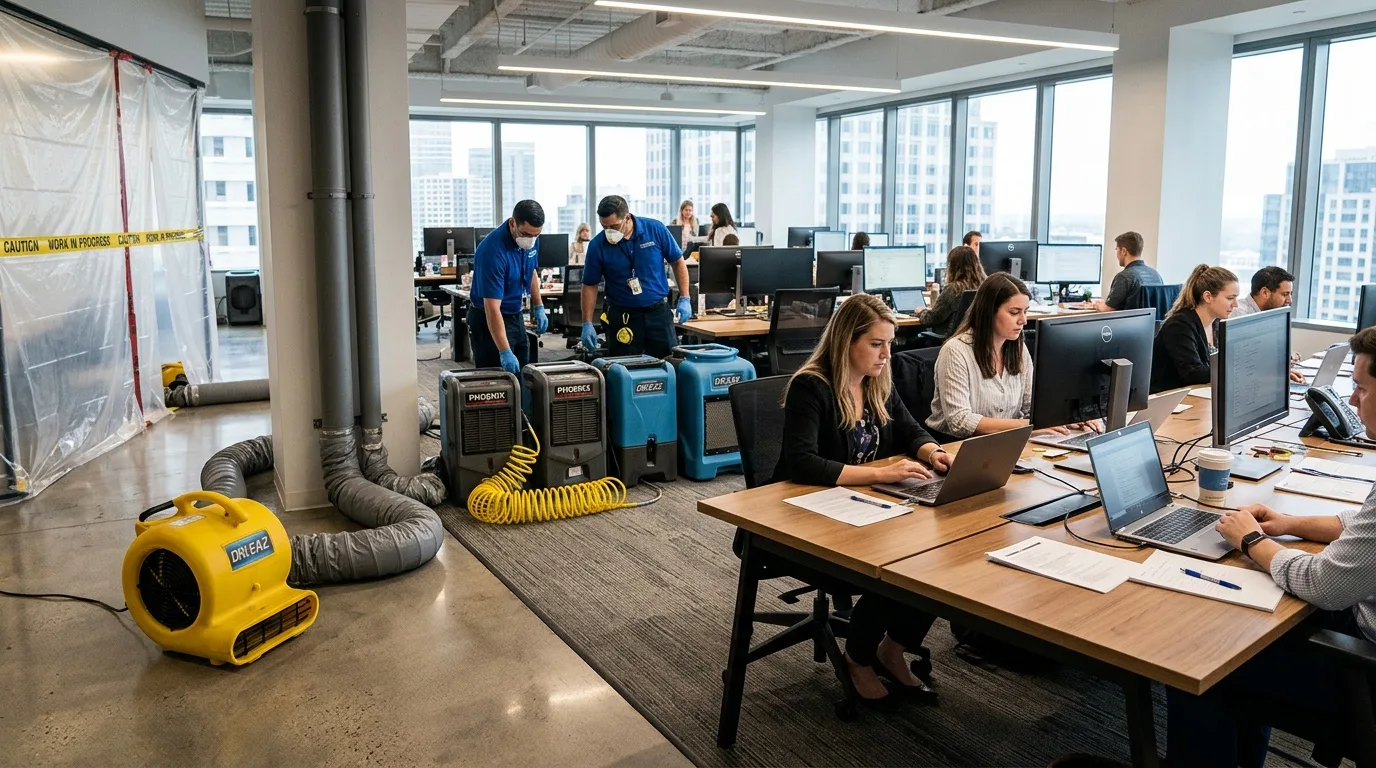
If the company cannot temporarily relocate to another space, restoration can be done in stages, zone by zone. The office or commercial space is divided into several sections, and work proceeds through each one sequentially.
The process looks roughly like this:
- Clear the first room or section of the space.
- Carry out the necessary restoration work — drying, mold treatment, replacement of damaged materials.
- Install furniture and verify that utilities are working.
- Move staff or operations into the finished area.
- Proceed to restoration of the next zone.
All loud and dust-producing operations — demolition, drilling, cutting — should be scheduled for after-hours or weekends whenever possible. When planning the timeline, account not only for the work itself but also for delivery of materials, drying time for construction compounds, cleanup, and ventilation of the space.
Protecting staff and equipment
The restoration zone must be separated from the functioning part of the business. Temporary partitions, heavy plastic sheeting, and protective barriers help reduce the spread of dust and debris into areas where work continues. Computers, servers, printers, and other equipment should be removed from any area undergoing repair. Construction materials and tools should not be placed in walkways or near emergency exits.
Maintaining critical systems
Before restoration begins, determine which systems must remain operational at all times. For most Carlsbad businesses, the critical list includes electricity, internet, phone service, ventilation, and security or access control systems. If temporary shutoffs of power or internet are unavoidable, notify employees and clients well in advance.
Communicating with clients
If restoration work affects the entrance or the customer-facing area, install clear signage directing people to a temporary entrance or an alternative service point. Clients should be informed ahead of time about any changes — through email, a notice on the door, or an update on the business website. Even a short message explaining that the business is open during restoration can prevent the loss of regular customers.
Dealing with insurance
File a claim with your insurance company within the timeframe specified in your policy, attaching the full set of documents — the inspection report, photos, the assessor's report, and the inventory of damaged property. Many commercial property policies in California cover water damage, but the details vary significantly.
If the payout seems too low, request a detailed breakdown of how the amount was calculated. You can order an independent review of their report and submit a written objection. If the insurer refuses to adjust, the matter can be taken to court.
Identifying who is responsible
Depending on the circumstances, responsibility for commercial water damage may fall on different parties:
- The property owner or landlord — bears the burden of maintaining the building. If the leak resulted from aging pipes or a failing roof, the owner is typically responsible.
- The building management company — responsible for upkeep of shared building systems, including water supply and drainage infrastructure. This is the most common defendant in flooding disputes.
- A neighboring tenant — if the water came from their space due to their negligence or faulty equipment.
- The builder or developer — may be liable if the damage resulted from a construction defect within the warranty period.
When the commercial space is leased, liability can be split between the landlord and the tenant depending on the terms of the lease agreement. This frequently leads to multiple disputes running simultaneously, which is one reason thorough documentation from the start is so important.
Costs you can recover
A claim for commercial water damage can include several categories of loss:
- Repair and restoration of the premises, including anti-mold and anti-fungal treatment.
- Cost of damaged inventory and other property — fixtures, registers, equipment.
- Lost income during the forced closure or reduced capacity period.
- Costs of the assessment, inspection, and any legal expenses.
Proving lost income requires documentation — financial statements, prior revenue records, and evidence that the water damage was the direct cause of the interruption. The stronger the paper trail, the more likely a full recovery.
Preventing future incidents
After restoration is complete and the business is back to normal, it is worth taking steps to reduce the risk of a repeat event. Inspect plumbing and drainage systems regularly. Verify that the building's roof and exterior walls are properly sealed. Install water leak sensors in areas with high risk — near water heaters, HVAC systems, and supply lines. For businesses in older Carlsbad buildings, pipe condition is a particular concern, as aging infrastructure raises the probability of a sudden failure.
Commercial water damage is disruptive, but it does not have to shut a business down entirely. Zone-by-zone restoration, clear communication with staff and clients, and careful documentation from the first hour all contribute to keeping operations alive while the space is repaired.
This site is Carlsbad-focused; for the wider operation behind it, see pack-out and restoration in Carlsbad.