

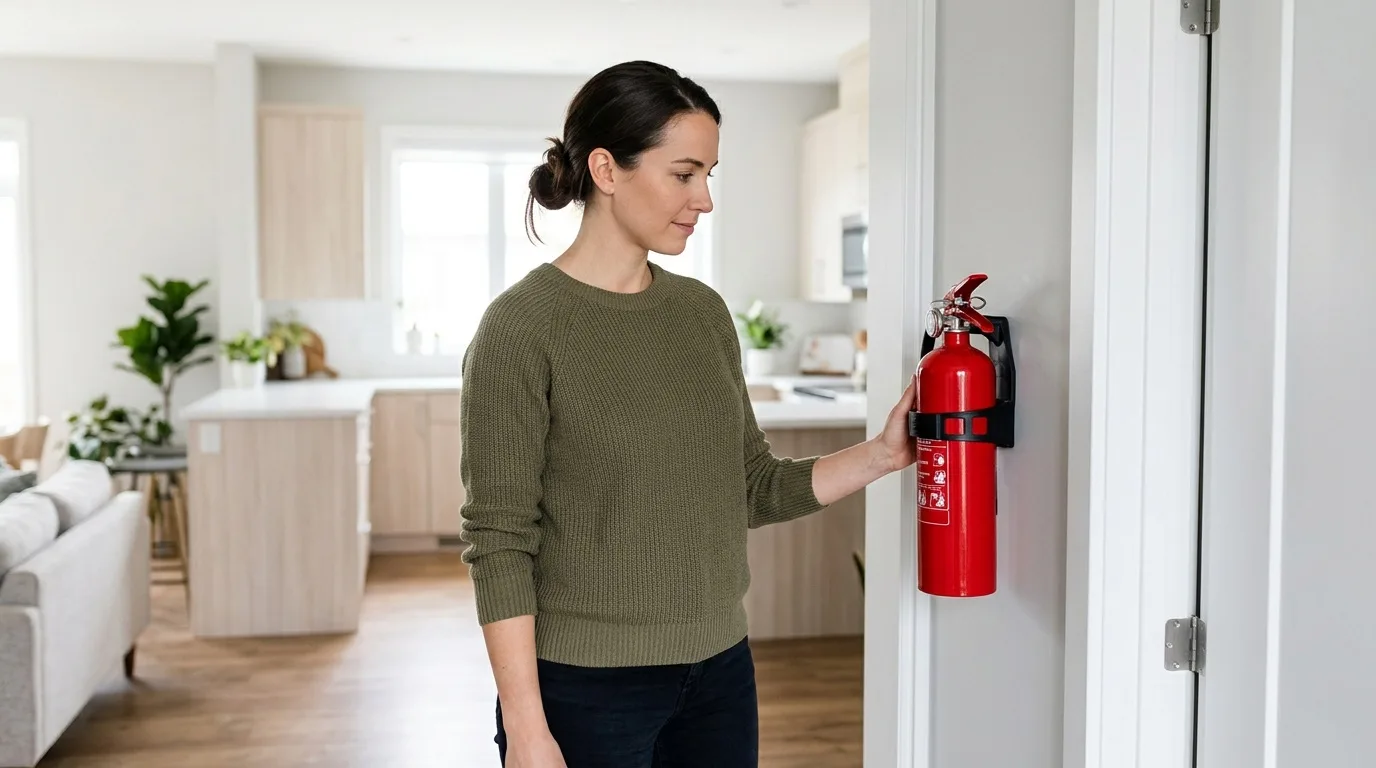
Do you have a fire extinguisher at home? What kind is it? Does it still work? These things seem minor until something goes wrong. Below we go through what fire extinguisher for home use makes sense, and why you need one at all.
A fire extinguisher is the first tool for fighting a fire before firefighters arrive. It can help with a burning appliance, furniture, oil on the stove or a short in an outlet. Even a small home extinguisher can stop a fire from becoming a serious one.
A fire extinguisher is a basic part of safety in any home. It helps protect property and can save a life. But it is not enough to simply own one. You have to pick the right type and know how to use it. Whether a fire is put out quickly or turns into a large blaze often depends on that choice. As a company that does fire damage restoration in Carlsbad homes, we see what happens after a small fire that was not stopped in time.
Fire Classes: Which Class Fire Extinguisher for Kitchen, Garage and Living Room
The choice of extinguisher depends on the type of fire. Using the wrong type can make things worse: it can spread the fire or cause an electric shock. Fires fall into these classes:
- Class A – ordinary combustibles: paper, wood, fabric, straw.
- Class B – flammable liquids and gases: gasoline, paint, the gas on a gas range or heater.
- Class C – energized electrical equipment: computers, TVs, game consoles, wiring.
- Class D – combustible metals: lithium, magnesium.
- Class K – cooking oils and fats: vegetable oil, olive oil, animal fat.
Keep an extinguisher on every level of the house. Best of all are multipurpose ABC units, which work on most fires in a home.
Types of Fire Extinguishers for the Home
A modern home should take into account the main types of extinguishers.
Dry Chemical (ABC Fire Extinguisher)
Multipurpose. It works on almost every kind of fire: wiring, plastic, wood, flammable liquids. The powder forms a crust that smothers the fire and stops it from spreading. Downside: it leaves a white powder that is hard to clean up. The powder is also irritating to breathe and cuts visibility in a smoky room. Where it fits: an apartment, a house, a garage, a kitchen.
Carbon Dioxide (CO2)
Puts out fire by cooling it and pushing out the oxygen. Good for electrical equipment, since it leaves no trace and does not harm electronics. It is often used in offices. Downsides: it does not work well outdoors or on burning fabric, and it will not put out smoldering material (carpet, furniture, wood). After the gas clears, the fire can flare up again. Where it fits: a home office, a kitchen.
A CO2 extinguisher can be handy at home. Once the fire is completely out, it is enough to air out the room. One thing to know: during discharge a CO2 extinguisher gets very cold, so hold it by the handle, never by the discharge horn. Its advantage is that it can put out sparking wiring, and you can use it without worrying that the agent will reach bare wires.
Water and Water-Foam
Water extinguishers are for Class A fires: wood, paper, straw, coal, rubber and plastic items, upholstered furniture. They work by spraying water and cover a large area. Some models contain additives that make them more effective. Pros: simple, cheap, easy to find. Downside: they must never be used on electrical appliances. Where they fit: a living room or a kid's room, as long as there are no electronics.
Foam
Foam extinguishers are for Class A and B fires (solids and liquids). They are often used on gasoline, paint, solvents. They cannot be used on cooking oils. They leave residue and cost more than water units.
Wet Chemical (Class K)
These are for Class K oil and grease fires. They spray a special mist that reacts with the oil and fat, cools it and puts the fire out. They are meant for commercial kitchens with deep fryers and other equipment that uses a lot of oil.
Water Mist
Suitable for many common classes: solids and electrical. They put out both flame and smoldering. They are environmentally friendly and do not damage appliances, but they cost more. They are convenient as an all-purpose option for a single-family house.
Which Fire Extinguisher for Kitchen and the Rest of the House
The U.S. Fire Administration fire extinguisher guide says multipurpose extinguishers labeled "A-B-C" or "B-C" work on most home fires. Class K units are meant for cooking oils in commercial kitchens. Two common types compare like this:
- A CO2 extinguisher – leaves no residue, and things are not ruined after use. It can be used on appliances and electronics. Its weak point: it does not put out smoldering.
- A dry chemical extinguisher – puts out both flame and smoldering. Its weak point: the powder is irritating and makes a mess. After use, watch the area to make sure nothing is still smoldering.
So for most homes the main pick is a multipurpose A-B-C extinguisher. A CO2 unit can be a second extinguisher for a home office full of electronics. For a fire extinguisher for grease fire on a stovetop, look for a unit rated for Class B or K on the label.
What Size Fire Extinguisher for Home
- About 2–5 pounds – compact, good for a kitchen or entryway.
- About 10 pounds – an all-purpose choice for an apartment or a small house.
- Over 13 pounds – for garages, workshops, large spaces.
The main thing is to balance capacity and weight. Make sure the extinguisher is not too heavy for you to lift. An extinguisher you cannot pick up quickly during a fire is no help.
What Else to Check When Buying
- Labeling. It should show the date of manufacture, the UL listing and the fire class the extinguisher is rated for.
- Seal and gauge. On a dry chemical unit the gauge needle should be in the green zone.
- Body. No cracks, dents, rust or deformation.
- Pin, hose and nozzle. Clean and intact.
- Weight and inspection tag. Check them against the label.
Where to Keep a Fire Extinguisher
- In a visible, easy-to-reach spot – not in a closet under a pile of things.
- Away from heaters, sunlight and moisture – and out of reach of children.
- Upright, in a dry place – avoid freezing temperatures.
- In a house – it can hang in the hallway, in the kitchen near the exit, next to the garage. Keep one on each level.
The best option is to mount the extinguisher on the wall with its top no higher than about five feet, so it is easy to grab fast.
How to Use a Fire Extinguisher: PASS
The U.S. Fire Administration describes the PASS method:
- Pull the pin.
- Aim low, at the base of the fire.
- Squeeze the handle.
- Sweep from side to side.
When Not to Fight the Fire
An extinguisher is only for a small fire that is not spreading. If the fire is growing, the room is filling with smoke, or you are not sure which extinguisher you have, get everyone out, close the door behind you and call 911 from outside.
If you use the wrong extinguisher, it can spread the fire or cause an electric shock. Never put water on an oil fire or on electrical equipment.
How Long a Home Fire Extinguisher Lasts
Service life and service intervals are set by the manufacturer, so check the label and the manual. A dry chemical extinguisher is recharged after any use. A CO2 extinguisher needs recharging after use or if it loses weight. A water mist unit is recharged according to the service schedule. Once a year it is worth having the extinguisher fully checked by a professional. If the gauge needle is in the red zone, it needs recharging.
After the Fire
Powder residue is fine and corrosive, so it should be cleaned off surfaces and electronics soon after the fire. Smoke and soot are a bigger job: we do pack-out and contents cleaning services and have a guide on protecting valuables during home restoration. Water from the fire hose often brings its own problems, covered on our water damage restoration page. You can learn more about our Carlsbad team, read what our customers say about us, browse more home safety articles or go back to our restoration company home page.